Carpenter Nails It.

The Supreme Court said today that just because you carry a cell phone doesn’t mean you’ve given up all your privacy rights.

The Court held 5-4 that the practice of law enforcement being able to demand from cell phone service companies the record of where you have been (because cell phones transmit their location to cell phone towers essentially continuously), as a general investigative tool, is unconstitutional. From now on, barring exceptional circumstances, investigators will have to obtain a warrant to acquire that information, because it is subject to 4th amendment protections.

Key to the decision was this language from Roberts:

“The Government’s position fails to contend with the seismic shifts in digital technology that made possible the tracking of not only Carpenter’s location but also everyone else’s, not for a short period but for years and years.”

The decision is here.

Putting Surveillance On ICE

By Admin

By now, many of us have read the gut-wrenching reports of ICE agents separating immigrant families at the border, including children from their mothers. While this story won’t be my focus, it provides us with yet more confirmation of ICE’s state-sponsored terrorist tactics.

So it might surprise you that we still get these sorts of questions:

“Why are you all so focused on ICE? What do they have to do with my privacy rights?”

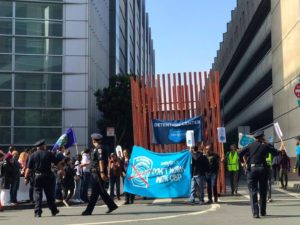
We get them a lot, in fact, because where there’s a fight to be had against the Immigration and Customs Enforcement agency (ICE) in the Bay Area, you’ll probably see Oakland Privacy organizing and advocating, alongside a coalition of groups and outraged citizens, for the most vulnerable people in our communities.

No More Non-Policies

by Christina Rosalita

“Policy after Procurement” has been, until recently, the unofficial non policy of blatantly experimenting until there is dissent or surreptitiously monitoring and using excuses as needed to justify. This approach is not in keeping with the promise of a sanctuary state; not for anyone.

In response to this, real policies are now being established. The Surveillance Equipment Requisition Ordinance (SERO) and Sanctuary Contracting Ordinance, or “Deport ICE”, provide the regulatory structure necessary for responsible acquisition and use; including provisions for data sharing and duration of retention. “Deport ICE” ends direct data sharing with ICE, an agency that uses data for high tech hunting of immigrant communities.

License Plate Readers: A Portrait of Fremont

According to data from the Northern California Regional Intelligence Center (NCRIC), the city of Fremont collected 14.5 million license plates and photos from license plate readers located throughout the city from December 2016 to October 2017.

The installation of stationary license plate readers was approved by the Fremont City Council on July 14, 2015, without any public comment or discussion during the meeting.

36 Major Netroots Groups Launch StopTheFCC.net To Save Net Neutrality

On the day the FCC order ending net neutrality rules goes into effect, some of the country’s largest netroots group are launching an effort urging representatives to force a floor vote to save net neutrality

FOR IMMEDIATE RELEASE
June 11, 2018
Contact: Mark Stanley, 202.681.7582, press@demandprogress.org

Today, with the FCC’s repeal of net neutrality protections set to go into effect, a coalition of major netroots groups is launching StopTheFCC.net.

StopTheFCC.net is an activism site that will drive hundreds of thousands of emails and tens of thousands of phone calls to representatives’ offices urging them to sign a discharge petition to force a floor vote on the Congressional Review Act (CRA) resolution to restore net neutrality.